


How the trail refined my color-coded packing system

Here’s the scenario. You’re out backpacking for the weekend, moving steady under clear skies just like the forecast promised. Then it shifts. The light drops. The wind picks up. Clouds roll in faster than they should.
You stop and reach for something simple, but it’s buried. So you dump your pack. Now your gear is scattered across dirt and leaves, sliding with every gust, blending together into one frustrating pile. You know what you need is there, but you can’t see it, and every second spent digging feels longer than it should. The sun is slipping, and what started as a small inconvenience is turning into a problem.
These moments don’t come out of nowhere. They happen because people have lived them, and because small gaps in preparation show up at the worst times. So how do you stay ahead of that? How do you build a system that still works when you’re tired, rushed, or dealing with conditions that change faster than expected? And how do you make sure a simple delay never turns into something bigger?
From idea to trail test
In a previous article, I laid out a color-coded packing system built around purpose instead of individual items. At home, it worked exactly how I imagined it would. I laid everything out, grouped it cleanly, and packed with confidence that each category had a clear role. It felt efficient, organized, and almost effortless when nothing was moving and there was no pressure. But that kind of clarity only exists in controlled conditions, and the trail doesn’t give you that.
So I took it out and put it through it.
I headed to a local trail that cuts through woods and open fields, weaving along the edge of a lake. The morning started cool in the upper 60s, but by the time I finished, it had climbed into the mid-80s and felt like a different day entirely. I didn’t just hike. I forced the system to work. I built a fire fast, set up a tarp lean-to, filtered water, and cooked a meal like I needed it, not like I was practicing. I tested new gear along the way, including a compass and a few tools, making sure everything had a reason to be there.
I treated the whole day like conditions were turning on me.
Out there, nothing stays neat. You stop to grab water, swap a layer, or check your direction, and suddenly everything is in motion. Gear shifts. Bags get opened and closed quickly. Items go in and out without much thought. That clean structure you had at home starts to blur. I found myself moving fast, opening different bags back-to-back, trying to stay ahead of what I needed before it became urgent. That’s when it hit me. A system isn’t tested when it’s packed. It’s tested when you’re using it under pressure.
By the end of the trip, I had a clear picture of what held up and what didn’t. The system didn’t fail, but it exposed every point of friction. Some categories felt automatic, like I didn’t even have to think about them. Others slowed me down just enough to notice, and that’s all it takes. Those small delays stack up, especially when conditions are shifting and time matters.
What held up
The strongest part of the system was the core idea of packing by purpose instead of by item. That shift sounds simple, but on the trail it changes everything. When I needed water, I went to Blue without thinking. When I needed tools, I went straight to Gray. Even when I was moving quickly or a little fatigued, that clarity held up. It cut out hesitation and kept my focus on solving the problem in front of me instead of digging through gear.
Navigation and communication held that same level of clarity. Everything tied to awareness lived in one place, which made it easy to check my position, manage light as the day shifted, and stay oriented without breaking stride. I wasn’t opening multiple pockets or second-guessing where something might be. The same was true for my medical kit, which stayed exactly where I expected it to be every time I reached for it. These categories worked because they were tight, focused, and didn’t compete with anything else.
Even as gear came in and out of the pack throughout the day, those core colors stayed consistent. I could open my bag, catch a glimpse of a color, and immediately know what problem it solved. That kind of instant recognition matters more than you think when time and conditions start working against you. It kept things moving, kept decisions simple, and reduced friction in moments where small delays can add up. More than anything, it showed me the foundation of the system was solid and worth refining, not replacing.
Where it broke down
The issues showed up when categories were doing too much, and Green was the clearest example. I had clothing, shelter, fire, hygiene, and insect control all grouped together because they all relate to surviving the environment. That logic holds up in theory, but in practice, it created a crowded, unfocused category. When I needed something specific, I had to sort through items that technically belonged there but didn’t solve the immediate problem. That forced me to pause, think, and dig, which is exactly what a good system is supposed to eliminate. It highlighted an important lesson. A category can be logically correct and still be functionally inefficient if it slows down access.
Fire exposed that problem even more clearly. By placing it within Green, I treated it as just another part of environmental survival rather than what it really is: a time-sensitive capability. When I reached for it, I had to think about where it was within a larger group rather than going straight to it. That moment of hesitation may seem small, but it becomes critical as conditions change. Light fades, temperatures drop, and suddenly fire is no longer optional. It becomes a priority. The takeaway here is simple. High-priority tools need visual and mental separation so they can be accessed without thought.
The combined Blue category revealed a different kind of friction. Food and water were grouped together because they both support energy and movement, which makes sense at a high level. But on the trail, they are used in very different ways and at different times. Water is constant and frequent, while food is periodic and often tied to breaks. By grouping them together, I created a category that required sorting every time I opened it. I wasn’t just reaching in and grabbing what I needed; I was searching within the category itself. That added friction to simple tasks and showed that shared purpose doesn’t always mean shared storage.
What changed and why
,After the field test, I didn’t try to rebuild the system. I focused on reducing friction. That meant paying attention to every moment where I had to pause, think, or search, and asking why it happened. Some categories held up under pressure, but others revealed small delays that added up over the course of the day. Those moments pointed to a simple truth. A system can be logically sound and still need refinement if it slows you down in real use.
The biggest pattern I noticed was a mismatch between how things were grouped and how they were actually used. Some items lived together because they shared a purpose, but on the trail, they weren’t accessed the same way or at the same time. That forced me to sort within categories instead of simply reaching for what I needed. It introduced an extra step that didn’t exist at home but became obvious once everything was in motion. That kind of friction is easy to overlook until you’re tired or trying to move quickly.
I also saw how certain tools and functions needed more visual and mental priority than they were getting. Not everything carries the same level of urgency, and grouping high-priority items alongside less time-sensitive ones created hesitation. In those moments, even a second of uncertainty stood out. It became clear that some parts of the system needed stronger separation so they could be accessed immediately, without thought.
At the same time, I realized that some categories were simply doing too much. When too many different functions live under one color, you’re forced to mentally filter every time you open it. That increases cognitive load, especially when conditions aren’t ideal. Breaking those groupings into smaller, more focused pieces wasn’t about adding complexity. It was about eliminating the need to think through a category's contents before acting.
At first glance, adding sub-colors might seem to complicate things, but the opposite is true. It doesn’t add more decisions; it removes them. Instead of one overloaded category, you now have smaller, clearer groupings that are easier to manage and faster to access. Each color still answers a single question, but now it does so without internal clutter. That added clarity is what makes the system work when you’re tired, moving fast, or dealing with changing conditions.
The system no longer asks you to think about where something is. It lets you act based on what you need. That’s the real goal, and that’s what the trail pushed this system toward.
Bard’s revised color-coded system
Before getting into the details, it helps to step back and see the system as a whole. Each primary color represents a problem you might face on the trail, not just a group of items. After field testing, some of those categories were refined and further broken down to make them faster and easier to use under less-than-ideal conditions. The goal is simple: you don’t search for gear, you solve a problem by reaching for the right color.
Gray | Tools & gear management
This one did not change after field testing. I successfully completed the tasks I needed, and after review, they remain the same.
Gray is everything that helps you work, fix, build, or manage your gear. When something breaks, needs adjusting, or requires effort, Gray is where you go. It carries your knife, multi-tool, saw, cordage, repair kit, tape, carabiners, pack net, trekking poles, and work gloves so you can solve problems without hesitation.
REVISED: Blue | Food & Water
Blue was originally a combined category that held both food and water. It included water bottles or a bladder, a filter or purification tablets, food, electrolytes, and even a stove or cook kit. Hydration and fuel were grouped together because they both support movement and energy on the trail.
After field testing, I realized this category was too broad to be effective. I found myself opening multiple blue bags and sorting through them just to separate water needs from food, which added an unnecessary step every time I reached for something. That extra searching slowed down simple actions that should have been immediate. It made it clear the category wasn’t aligned with how I actually use those items on the trail.
REDUCED: Blue | Water system
Blue is now focused entirely on hydration and water safety. It holds your bottles or bladder, filter, purification tabs, collapsible storage, and electrolytes so you can stay ahead of dehydration without slowing down.
NEW: Light Blue | Food system
Light Blue handles everything tied to calories and cooking. Your food, snacks, stove, fuel, cook kit, and utensils all live here, so breaks are simple and efficient without unnecessary digging.
REVISED: Green | Clothing, shelter, and environmental survival
Green originally carried everything related to staying alive and comfortable in the environment. It included clothing, shelter, fire, hygiene, and even bug protection, all grouped into one large category. The idea made sense at home, but it became too crowded once I was on the trail.
After field testing, this was the category that needed the most refinement. Too many functions were grouped together, so I had to sort through items just to find the one I actually needed. That became especially noticeable when switching between layers, dealing with insects, or trying to quickly access shelter gear. Instead of moving straight to a solution, I was filtering through the category itself, which slowed things down more than it should have.
REDUCED: Green | Clothing & layers
Green now focuses strictly on what I wear and adjust throughout the day. It holds my rain shell, insulation, extra socks, hat, and gloves so I can regulate temperature without unpacking everything else.
NEW: Kelly Green, “Kleen” | Hygiene
Kelly Green separates hygiene items so they no longer compete with survival gear. It holds wipes, a toilet kit, hand sanitizer, a toothbrush, a small towel, and sunscreen so I can clean up quickly and stay functional.
NEW: Light Green | Insect & pest control
Light Green isolates insect and pest management into its own category. Bug spray, anti-itch cream, bite and sting relief, tick tools, and deterrents all live here, so I can deal with bugs immediately without searching.
.
NEW: Dark Green | Shelter & survival
Dark Green now holds the gear I rely on when I stop or when conditions turn. It includes my tarp or tent, sleep system, groundsheet, and emergency blanket so I can set up quickly when it matters most.
Red | Medical
This category did not change after field testing. It performed exactly how I needed it to, and I was able to access everything quickly when required.
Red is for when something goes wrong and time matters. It holds your first-aid kit, blister care, medications, and trauma essentials so you can respond immediately without digging or second-guessing. This category is built for clarity and speed, because hesitation is the one thing you can’t afford when you need it.
Black | Defense
Black also remained unchanged after field testing. It stayed clear and purpose-driven, which is exactly what I want from this category.
Black is reserved strictly for defensive tools, with nothing else mixed in. Keeping it separate eliminates hesitation and ensures there’s no confusion about its purpose. If you ever need it, you know exactly where it is and what it’s for.
It’s also important to understand and follow local laws and regulations regarding personal protection. These can vary widely depending on where you are, especially across state lines or in different parks and public lands. When in doubt, consult local law enforcement or a qualified attorney to make sure you’re in compliance. Bard does not provide legal advice.
REVISED: Yellow | Navigation, light, communication
Yellow originally focused on navigation, light, and communication. It included items like a map, compass, GPS or phone, lighting, and signaling tools. Documents were originally in their own category, separate from this one.
After field testing, I realized documents didn’t need to stand on their own as a separate category. They’re rarely accessed while moving and almost always come into play alongside navigation, planning, or communication. Keeping them separate created an extra layer that didn’t add value in real use. Folding them into that broader awareness category made access simpler and the system more streamlined.
ENHANCED: Yellow | Navigation, light, comms, and documents
Yellow now combines navigation, lighting, communication, and documents into a single category. It holds your map, compass, GPS or phone, headlamp or flashlight, lantern, battery pack, whistle, signal mirror, camera, ID, permits, contacts, cash, and trip plan, so everything tied to awareness and orientation lives together.
REPLACED: Orange | Essential documents
In the previous version, documents were classified as orange. Even when packing, I realized this was wasted space to put my ID or wallet into an orange dry bag by itself. It made sense to be combined with similar items, so I decided, after the field test, to move this to Yellow. But what would I do with all those orange dry bags?
NEW: Orange | Fire
Fire was originally grouped within Green as part of the broader survival system. While that made sense conceptually, it did not work well in practice. After field testing, I realized fire needed to stand on its own. It is too important and too time-sensitive to be buried within another category, especially when conditions change quickly.
Orange now stands alone as the fire system, giving it the visibility and priority it deserves. It holds your lighter, ferro rod, tinder, and fire starters, all grouped so there’s no question where to go when conditions shift. When you need heat, you’re not searching or sorting, you’re grabbing and acting. That clarity makes a difference when time and conditions are working against you.
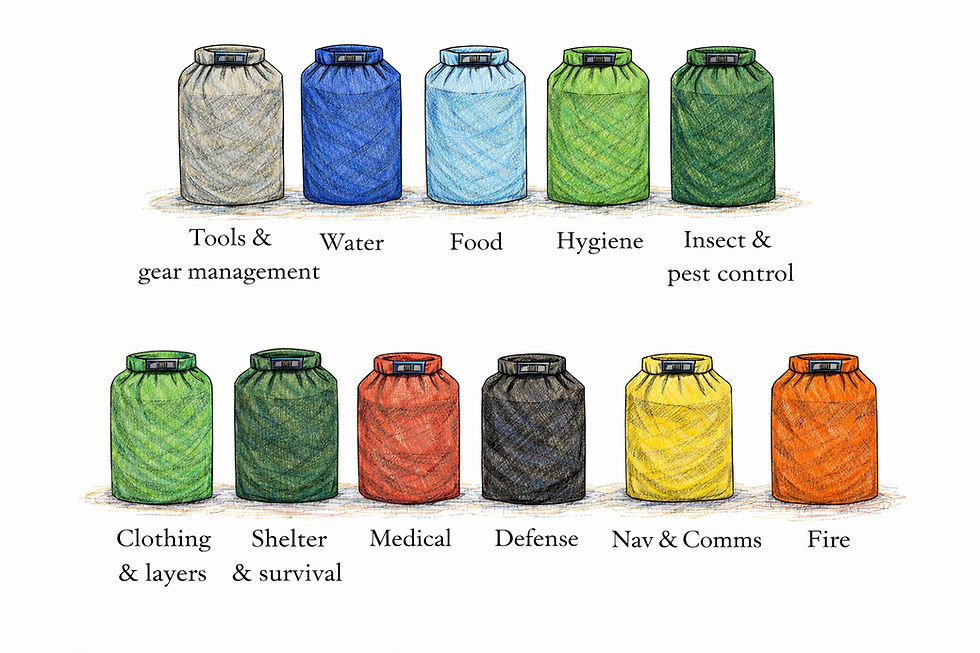
Putting it all together, here is the refined system after field testing and making adjustments where they mattered most. Each color represents a specific purpose, and the subcategories bring clarity without adding complexity. The goal is simple: remove hesitation, reduce searching, and make every decision on the trail faster and more intuitive. Bard's revised color-coded packing list
Gray: Tools & gear management
Blue: Water (blue) and food (light blue)
Green: Hygiene (Kelly green), insect & pest control (light green), clothing & layers (green), and shelter & survival (dark green)
Red: Medical
Black: Defense
Yellow: Navigation, light, communication, and documents
Orange: Fire
How to pack it so it works
The system matters, but where you place it matters just as much. On a pack like the Osprey Kestrel 38, you have natural zones that should match how often and how urgently you need things. The top lid and quick-access pockets should hold your highest-priority items, so you’re not digging when conditions shift. When something changes fast, your pack should respond just as quickly.
I keep Yellow and Red up top because they address immediate problems like direction, lighting, and injury. Orange can live there as well if conditions call for quick fire access, especially in colder or unpredictable weather. Blue rides in side pockets or other easy-access areas because water is constant and should never require you to unpack your bag. Light Green fits well in an outer pocket since insect pressure comes and goes throughout the day.
Inside the main compartment, your system really takes shape. Dark Green sits deeper since shelter, and sleep comes out when you stop, not while you’re moving. Green clothing layers sit above that, so you can adjust quickly without unpacking everything. Light Blue food lives mid-pack, so it’s easy to grab during breaks, while Gray tools stay accessible but not in the way.
What this creates is a pack that mirrors how you think on the trail. The outside handles constant needs, the top handles urgent ones, and the core carries what you’ll need when you stop. When everything ends up on the ground again, because it will, you don’t start over. You rebuild by color and get moving again.
Build it, test it, refine it
A system like this is never finished, and that’s part of what makes it useful. You build it with intention, you take it into the field, and then the trail shows you what actually works. Some parts will hold up, others will slow you down, and a few will surprise you. That process isn’t a flaw; it’s the point.
What matters is that your system works when things stop being easy. When your pack is open on the ground, when the weather shifts, or when you’re tired and not thinking clearly, you don’t want to rely on memory. You want something simple enough that you can act without hesitation. That’s what this revision gave me.
So build your own version of this, not by copying it exactly, but by testing it. Take it out, use it, break it, and adjust it until it fits how you move and think. Because in the end, the best system isn’t the one that looks good at home, it’s the one that still works when everything is scattered at your feet.


Comments