


Backcountry Bard is back
- Bard

- Mar 2
- 21 min read
Updated: Mar 3

Welcome back to Backcountry Bard. If you have been here before, you likely noticed this space went quiet for a season. That silence was intentional, even if it may not have looked that way from the outside. It wasn’t frustration, and it wasn’t burnout. It was a necessary pause to reassess what this space truly represents and where it should lead next. I reached a point where posting regularly felt less important than asking whether what I was posting carried weight. I needed distance from my own words to understand whether they pointed toward something real or described activity without depth.
During that pause, I began rereading older pieces and asking hard questions. Was I writing from conviction or from momentum? Was I sharing experiences because they shaped me, or because they made good stories? There is a difference between documenting miles and interpreting what those miles mean. I did not want Backcountry Bard to become a running log of accomplishments or a surface-level celebration of outdoor activity. I wanted it to reflect formation. That meant stepping back long enough to let the noise settle and the deeper current rise.
What became clear during that quiet stretch was that Backcountry Bard had to grow beyond updates and into something more grounded, more integrated, and more honest. The outdoors had shaped me too deeply for it to be reduced to anecdotes. Writing meant too much to remain casual. The people I’ve trained with, learned from, and walked beside deserved more than passing mentions. If this space were to continue, it needed to bear the full weight of those threads woven together rather than scatter them loosely across the page.
The word “bard” matters here, not in the sense of a performer on a stage, and not as a romantic caricature of a wandering storyteller strumming for applause. A bard, at least in the way I understand the tradition, pays attention. He walks through the world with eyes open. He listens before he speaks. He absorbs what land, weather, effort, and community teach him, and then he returns to articulate those lessons with care. The storytelling comes after the living.
That is the posture I want this space to hold. It is not about spectacle, performance, or cultivating an image. It is about reflection shaped by effort, and effort shaped by land. It is about acknowledging that what happens outside on the trail, in the water, in early-morning silence, or under load has consequences for the inner life. Backcountry Bard exists to explore that connection with steadiness rather than noise, depth rather than decoration, and honesty rather than performance.
Growing up in North Central Texas
I grew up south of Fort Worth, on the outer edge of what most people would call a bedroom community. It was close enough to the city that stadium lights glowed across the horizon on Friday nights, and new neighborhoods steadily replaced open fields. We could feel urban growth pressing outward, and with each passing year, more pavement appeared where pasture once held ground. That expansion was a normal part of life, and for a while, it simply felt like progress.
Yet we were also far enough out that rural life still defined our rhythms. Ranch gates stood a short drive away. Creeks ran through tree lines that had not yet been cleared. The wind crossed open pasture without interruption from traffic noise. You could step outside at night and see stars clearly enough to remind you that the world did not revolve around city limits. That duality shaped how I saw things early on: the convenience of town life within reach, but the grounding presence of land close enough to feel real.
Outdoor activities were never framed as hobbies. They were simply a part of how the seasons moved and how life unfolded. We hiked before we ever called it hiking. Wandering creek beds and pasture trails were playgrounds without tracking distance or elevation; just moving because there was ground to cover and curiosity to follow. We swam in stock tanks, lakes, creeks, and rivers when the heat demanded relief. We climbed trees for a better view, camped out under a wide sky without elaborate gear lists, and canoed stretches of water to see what was around the next bend. The outdoors was not scheduled recreation carved out after responsibilities were met. It was the environment in which responsibility itself was learned.
Growing up hunting taught lessons that had very little to do with pulling a trigger and everything to do with discipline, restraint, responsibility, and respect for something beyond yourself. Dove season taught me patience under heat and glare, scanning the sky for motion that demanded focus rather than distraction. Turkey season required pre-dawn stillness, the kind that forces you to confront your own restlessness while waiting for that first distant gobble to echo across low hills. Deer season demanded hours of quiet observation, learning to recognize the subtle difference between wind moving brush and something alive stepping carefully through it. Each season carried its own discipline, and over time those disciplines shaped attention in ways I only appreciated years later.
Fishing carried a different tempo altogether. When the sand bass ran up the rivers, we followed without second-guessing, wading into the current with rods in hand and cool water pressing steadily against our legs. Standing knee-deep in moving water while fish struck hard forced a presence in a way no classroom ever could. The lakes offered largemouth bass near submerged timber, and catfish pulled patiently from deeper water; those long days unfolded without urgency or notice, pulling us elsewhere. Sunburned shoulders, mud-caked boots, tangled lines, and the steady rhythm of casting and retrieving formed something internal long before I had the language to describe it. The land was not a decoration or backdrop. It was a teacher, a testing ground, and a quiet architect of character.
Looking back, I understand that those years were not simply childhood memories but a quiet apprenticeship. The land was shaping instincts long before I knew to call them values. Attention, patience, humility, and endurance were being formed in pasture, river current, and pre-dawn stillness. At the time, it was just life unfolding naturally, but it laid a foundation I would return to again and again as the horizon widened beyond Johnson County.
Off to the "Wild Blue Yonder"
Joining the United States Air Force carried me beyond the familiar horizons of North Central Texas and into something far larger than I had imagined. The phrase “Wild Blue Yonder” is often associated with aircraft and sky, but for me it came to represent crossing into terrain that would stretch not just my geography, but my identity. Leaving home meant trading pasture and low hills for mountain ranges and elevation that rose sharply instead of stretching flat. What I did not yet understand was how deeply that change in landscape would recalibrate my sense of effort, scale, and humility.
Being stationed in Colorado first reshaped how I understood endurance. In Texas, endurance was measured by distance. You walked farther, stayed out longer, covered ground under heat and wind. In the Rockies, elevation defined effort. It did not matter how many miles you had logged if you were not prepared to climb. The mountain does not negotiate; it simply rises.
Climbing above the tree line demands a patience entirely different from sitting in a deer stand before dawn. Your lungs work harder as the air thins, and every step must be placed deliberately. The incline exposes your conditioning and your ego simultaneously. There is no shortcut upward, no way to fake endurance. Your breathing becomes rhythm, your stride becomes calculation, and your focus narrows to the next ten steps rather than the horizon. And then you crest the ridge.
When you finally step onto a ridgeline and turn to look across miles of jagged peaks folding into one another, something internal shifts. The perspective is earned. The view is not just scenery; it is proof of effort. Alpine lakes sit below like sheets of polished glass, reflecting sky and granite with startling clarity. The wind moves unbroken across exposed terrain, sharper and cleaner than anything I had known growing up. At elevation, ego shrinks in the presence of immensity, yet confidence grows because you worked to stand there.
Colorado enlarged my sense of scale and sharpened my understanding of earned perspective.
After returning from a year in South Korea, I finished my time in the service in Idaho, except for a brief three-month stint in Saudi Arabia. That final stretch of service added another layer to my understanding of wildness. Idaho did not impose itself with a dramatic vertical rise, as the Rockies did. Instead, it unfolded in wide, open spaces that felt ancient and steady.
The high desert plateau stretched broad and quiet, carved deeply by rivers that had taken their time shaping stone. Canyon walls revealed the slow, patient work of water over centuries. The forests felt older than urgency, dense and hushed beneath the canopy. Standing beside isolated glacial lakes at sunrise changed my understanding of solitude. Silence, there was no emptiness. It was weight.
In Idaho, I learned that wildness does not always announce itself loudly. Sometimes it is the steady press of wind across sagebrush. Sometimes it is the still surface of cold water reflecting first light. Sometimes it is the awareness that you are a small figure moving through a landscape that existed long before you arrived and will remain long after you leave.
Those years expanded my internal map as much as my physical one. Texas had formed instincts. Colorado introduced elevation and earned perspective. Idaho deepened humility and silence. Terrain that demanded effort revealed that capability and humility grow together. The stronger and more capable you become, the more clearly you see how large the world truly is.
And yet, when military service ended, and I returned to Texas, something subtle began to shift again. Subtle began to shift again. The elevation changed. The scale compressed. And without realizing it at first, the friction that had sharpened me began to soften under familiarity and comfort.
Returning to Texas: The slow creep of Americana apathy
Coming back to Texas after my time in the service did not feel like retreat. It felt like stepping fully into responsibility. I met a girl, fell in love, and got married. I began building a career, bought a house, and started raising a family. Life, by nearly every outward measure, was good. There was stability, forward motion, and the kind of happiness many people spend years hoping to reach. That is precisely what makes what happened next so subtle and difficult to recognize as it unfolds.
Americana Apathy rarely grows out of tragedy or visible failure. More often, it grows out of blessing. You work hard to build something steady, and when you finally arrive at it, you allow yourself to exhale. Comfort feels earned. Routine feels deserved. You shift from striving to maintaining, from building to protecting, and that instinct is both natural and honorable. Yet somewhere in that transition, friction begins to fade quietly from daily life.
American life makes that transition almost effortless because convenience is woven into every layer of it. We live in climate-controlled spaces that insulate us from heat and cold, order meals without standing over a stove, and fill evenings with endless entertainment that demands little from us physically. Movement becomes optional rather than necessary, and discomfort becomes something we can decline rather than endure. None of these conveniences is wrong by itself, but repeated daily and over years, they recalibrate our threshold for effort and slowly reshape what feels normal, acceptable, and required.
The drift never arrives with headlines or alarms. It settles in quietly, disguised as reward, as rest, as something earned after years of effort. It begins with small decisions that feel harmless on their own: staying up late with a television glow filling the room while enjoying a peanut butter and jelly sandwich because the day seemed to deserve it, sleeping a little longer because nothing urgent demands rising, choosing the shorter path because the schedule feels tight, or letting early mornings slip by in favor of evenings that ask nothing more than presence. None of it feels like surrender. It feels like relief. And yet, over time, those small mercies accumulate into a pattern that shifts the baseline of effort almost without notice.
Places that once required intention begin to live only in memory. The mountains I climbed transform into stories told around dinner tables rather than destinations marked on a map. The rhythm of friction that once sharpened my focus softens beneath familiarity, and challenge becomes something optional rather than formative. The body adapts quickly to ease, and the mind follows without argument. What once felt necessary becomes excessive, and what once felt invigorating becomes inconvenient.
It can take years before the realization breaks through. You look up one ordinary day, not from collapse but from quiet stagnation, and sense that something essential has dimmed. There was no dramatic failure, no visible unraveling. The responsibilities are still met. The family is still loved. The work continues. Happiness, at least on the surface, remains intact. Yet beneath that stability, there is a muted space where clarity once lived, a subtle awareness that an edge once relied upon has dulled.
Americana Apathy is rarely loud or obvious. It does not resemble open laziness or neglect. Instead, it grows in the soil of blessing, in lives that are genuinely good and comfortably arranged. It replaces striving with maintenance and slowly persuades you that maintaining is enough. By the time you recognize it, the habits feel woven into identity, and the drift that began as harmless rest has quietly reshaped the contours of your life.
And yet, even in that season, something steady remained beneath the surface. Driving past open pasture at sunset stirred more than nostalgia. Cool morning air carried a faint memory of ridge lines and earned perspective. The clarity I once felt at elevation had not vanished; it had only grown quiet. Recognizing the drift did not come with fireworks or crisis. It came with a quiet realization that comfort had begun to define me more than effort. That clarity was uncomfortable in its own way, but it was also freeing. Once I could see the pattern, I no longer had to pretend it wasn’t there.
The question became simple: What do you do when you recognize you’ve grown soft in ways you never intended?
For me, the answer was not vague motivation or another temporary challenge. I did not need inspiration. I needed structure. I needed friction reintroduced deliberately into my life. I needed accountability that existed outside of mood and convenience. I needed something that would require consistent effort, not occasional effort.
That is when I found The Strenuous Life.
A reawakening: The Strenuous Life
When I found The Strenuous Life, I was not looking for inspiration. I was looking for structure. I needed something firm enough to push against, something that would not bend to mood or convenience. On the surface, it looked simple: physical standards, skill requirements, daily disciplines, measurable benchmarks. That simplicity is part of its strength. It removes negotiation. It replaces vague intention with visible effort. I quickly understood that if I wanted to reclaim something steady within myself, it would not come through reading or reflecting alone. It would come through repetition, weight, miles, and consistency.

The foundation of the program is personal responsibility. No one completes your disciplines for you. No one carries your load or practices your skills for you. You wake up and do a good deed. You shoulder the weight and move. You navigate Agons rather than defaulting to the ease of a screen. You practice until it moves from theory into muscle memory. You build skills in wind and damp conditions because ideal scenarios teach very little. The tasks are not flashy or complicated, but they accumulate quietly over weeks and months, reshaping not only strength but also posture and confidence. There is something transformative about returning to the simple truth that capability must be practiced or it fades.
Over time, those steady repetitions begin to restore what drift dulled. You stop negotiating with minor discomfort. You stop waiting for perfect conditions. You begin trusting your ability to adapt when plans unravel. The body strengthens, but more importantly, the mind steadies. Effort becomes familiar rather than threatening. Friction becomes a teacher rather than an obstacle. You start remembering that resilience is built slowly and deliberately, and that comfort, while pleasant, is rarely formative.
Yet The Strenuous Life does not confine itself to individual discipline. It is organized into regions and subregions, and those gatherings transform effort into community. We meet before sunrise, packs secured and boots laced, and step into miles together while the rest of the world sleeps. We practice navigation in open fields and wooded trails. We refine bushcraft skills that demand patience. Conversation flows and falls silent naturally as terrain requires attention. Shared miles dissolve superficial differences quickly. Sweat and fatigue remove pretense. What remains is honesty.
Beyond those local circles, there is a broader network that stretches across states and countries. Through technology, we stay connected, not in shallow commentary but in meaningful accountability. Progress is shared. Failures are admitted openly. Lessons learned through difficulty become instruction for others. Encouragement travels across time zones. What begins as structured training evolves into a tribe. We celebrate milestones without ego and push one another when complacency returns. There is a quiet understanding that individual growth strengthens the whole.
Then there are the Festivals of Strenuosity, where the individual and the collective merge completely. We gather in person, combine our skills into more demanding challenges, and push ourselves beyond what feels comfortable alone. Weight increases. Tasks grow more complex. Problem-solving happens under fatigue. It is never about proving superiority. It is about expanding capacity. When effort is shared, something amplifies. Limits shift. Perspective widens. Confidence deepens not because someone declared it, but because it was earned together.
What began for me as a corrective measure slowly became restoration. The Strenuous Life did not transform me into someone new. It reintroduced me to someone I had neglected. It reminded me how to wake early with purpose, how to move across ground deliberately, how to choose friction rather than avoid it. It restored steadiness where complacency had softened edges. It proved that growth does not require drama; it requires consistency.
As the miles accumulated and the skills sharpened, I began noticing a parallel change elsewhere. The discipline practiced outdoors began to shape the discipline I brought to the page. The patience required for navigation translated into patience with revision. The clarity that returned through distance walked appeared in sentences written. The steadiness that developed under load stabilized my voice. Physical effort and creative focus were no longer separate pursuits. They reinforced one another.
The reawakening was not confined to one area of my life; it moved through everything at once, restoring capability in my body, which in turn rebuilt confidence in quiet ways that steadied my thinking and sharpened my clarity, and that clarity gradually deepened my voice on the page. The Strenuous Life did more than place weight back on my shoulders during early morning rucks; it restored weight to how I lived each day, reminding me that effort shapes character, that shared hardship forges real belonging, and that comfort left unchallenged slowly wears down something essential inside us without ever announcing its work.
Bully!

Somewhere along those miles and disciplines, I began recognizing how much of my instinct already aligned with Teddy Roosevelt, not only in hunting and fishing, which had shaped me since childhood, but in the deeper convictions beneath them. Roosevelt believed that strenuous effort formed strong citizens, that wild places were not luxuries but necessities, and that conservation was not sentimentality but responsibility. He loved wild country not merely for recreation, but for what it demanded of a person and what it gave back in return. As I read more of his life and words, I found myself asking a question that stayed with me: if I admire those convictions, how should they show up in my own life?
That question followed me into my journaling. In the early days of reawakening, I wrote consistently, often late at night after miles under load or early in the morning before the house stirred. I was a pretty good journaler, and more than that, I enjoyed it. There was something honest about capturing the small victories, the fatigue, the lessons learned in wind and sweat. The act of putting experience into words slowed everything down and gave it meaning. As the pages filled, I noticed that the more I wrote about the outdoors and discipline, the more I loved writing itself. It stopped feeling like a record and began feeling like a craft.
That growing affection for writing did not remain private for long. It stirred something that had been present for years but was waiting for commitment. The journal pages revealed a pattern: the land and the effort were not just shaping my body or sharpening my convictions, they were shaping my voice. What started as a reflection became an aspiration, and that aspiration, along with my wife's encouragement, eventually drew me back into the classroom at the University of North Texas, where craft would be refined with the same seriousness with which miles and skills had been honed in the field.
A return to college: Creative writing, history, and finding my voice
While this physical reawakening was unfolding, another path was quietly taking shape alongside it. After 18 years, I returned to the University of North Texas. However, there was a major change: I now intended to pursue a degree in Creative Writing. I didn't return because I needed a credential, but because I wanted to close the "Unclosed Life Chapter" that hung like an albatross. I was also in a position in my life to pursue what I was passionate about. Writing had always been present in my life, but it had often lived in the margins, squeezed between responsibilities rather than given full attention. UNT gave me more. It required structure, critique, revision, and the humility to tear down sentences that did not carry their weight. That rigor strengthened something in me the same way rucking strengthened muscle: through repetition and friction.
In workshop rooms and during long nights bent over revision, I began to see a pattern I could no longer dismiss. Whenever I stripped away performance and wrote with honesty rather than ambition, the outdoors rose naturally to the surface of the work. Wind moved through the sentences. Water carved the metaphors. The land grounded reflection in something tangible and real. When I attempted to remove landscape from the frame, the writing felt weightless, as if it were drifting without anchor or consequence. But the moment I restored mountains, pasture, riverbanks, or the glow of firelight, the piece settled into itself with quiet strength. The land was never decoration in my stories; it was the foundation holding everything in place.
I returned to UNT a year after earning my writing degree. This time, it was to study History. Some people found that surprising, but for me it felt necessary. I was conceptualizing a project where I felt a degree would give me credibility, but I also got more. History trained me to think across generations, to see how terrain, resources, belief systems, and leadership shape entire cultures over time. It sharpened my understanding that land is never neutral. Rivers establish trade routes long before markets ever form, mountains define borders long before treaties are signed, and climate quietly shapes what people grow, build, and become. Studying history revealed that geography is not background scenery in the human story but one of its primary authors. It confirmed what instinct and lived experience had already been teaching me for years: the ground beneath our feet forms us more deeply and more persistently than we often recognize.
Studying history also deepened my humility in ways I did not expect. It reminded me that none of us move across untouched ground or exist outside the long arc of those who came before. The trails we hike today often trace old migration routes, the rivers we cast into once sustained entire communities, and the forests we wander through have witnessed centuries of struggle, settlement, and renewal. Seeing the landscape through that longer lens added weight to both my writing and my time outdoors. It shifted my posture from simple enjoyment to stewardship, reminding me that wild places are not ours to consume, but to respect, protect, and pass forward.
As these academic pursuits converged with the renewed discipline of The Strenuous Life, my sense of direction stopped feeling scattered and began to feel aligned. The miles under load sharpened my attention to detail and strengthened endurance, while historical study widened my perspective and anchored me within a much longer human story. Creative writing became the bridge between those experiences, giving language to effort and context to landscape. From that intersection grew a clear desire to pursue a Master’s in Creative Writing at UNT, not as a credential but as a refinement of craft. The goal is not to stack degrees, but to develop the skill necessary to render wild places and lived experience with care, precision, and honest depth worthy of the ground that shaped them.
At some point, I stopped seeing these pursuits as separate. The miles I walked informed the sentences I wrote. The history I studied deepened the meaning of the landscapes I traversed. The skills practiced in the field reinforced the discipline required at the desk. Everything was converging toward a single question: how do I live fully outdoors and then return to tell the story in a way that honors both the land and the lesson?
That question is what ultimately shaped Backcountry Bard as it stands now.
Backcountry Bard: Today and in the future
All of those threads, red dirt and mountain wind, drift and discipline, study and silence, begin to braid together here. Backcountry Bard is no longer a place only to record what happened outdoors. It is where experience and reflection meet, where effort on the trail returns as thought on the page. The goal is not to chronicle activity but to explore transformation. Time spent outside changes something in a person, and this space exists to slow down long enough to ask what that change actually is.
You will find writing rooted in practice rather than theory. Essays on hiking that look beyond mileage and into mindset. Reflections on rucking that wrestle with why carrying weight clarifies thought. Stories from hunting and fishing that linger not on success alone, but on patience, restraint, and reverence. Canoeing, navigation, and early morning miles under load are not just activities but laboratories of character. In the spirit of writers like Michael Easter and Robert Macfarlane, movement becomes inquiry and landscape becomes teacher.
Creative essays and stories will live here as well, shaped by the influence of voices such as Hemingway, Thoreau, and Leopold. Not imitation but conversation. Hemingway teaches restraint and honesty, the discipline of saying only what matters. Thoreau reminds us that deliberate living still requires intention and withdrawal from noise. Leopold insists that land carries moral responsibility and that our relationship to it defines who we are. Their echoes sharpen the work here and invite something more than admiration of scenery. They call us toward integrity, awareness, and action.

Photography will remain part of the conversation here, not as a portfolio meant to impress, but as a discipline of attention that keeps me honest. The act of lifting a camera slows everything down; it forces me to notice how light breaks across a ridgeline, how frost catches the first edge of dawn and glows for only a few fleeting minutes, how water can hold a perfect reflection until the slightest wind disturbs its surface. Those details are easy to miss when the goal is distance or pace, yet they are often where the deepest sense of wonder resides.
Over time, that practice shapes the way you move through the world. You begin to expect subtlety rather than spectacle. You look for quiet moments instead of dramatic ones. Attention itself becomes a kind of discipline, and like any discipline, it reshapes you from the inside. The more deliberately you notice, the more deeply you appreciate, and gratitude grows not from grand gestures but from learning to see what was there all along.
This space also steps beyond writing and image into a lived community. Backcountry Bard sponsors and supports a local rucking tribe, a hiking club, and a fun running herd, all built around shared miles and shared effort. These groups gather early, move deliberately, and resist the drift toward ease. We carry weight together. We climb together. We learn from one another. The point is not performance but presence. Outdoor wellness here is not aesthetic branding. It is resilience formed in the open air and strengthened through shared strain.

What I hope begins to take root through all of this is not admiration but ignition. The essays are not meant to replace the trail. The photographs are not meant to substitute for sunrise. They are meant to stir something that pushes you outward. If you sense a restlessness beneath routine, if you feel a pull when wind brushes your face or when a quiet path disappears into trees, that is not accidental. That is an invitation.
Backcountry Bard is becoming less a platform and more a compass. It points toward friction that forms, silence that steadies, and land that restores perspective. It offers stories not as destinations but as trail markers. The real journey is always yours to walk.
Step into your own story
If you have read this far, then something in you likely recognizes the quiet tension between comfort and calling, between the stability you have worked hard to build and the deeper hunger that refuses to fade. Most of us create good lives through steady effort. We shoulder responsibility, care for family, grow careers, and build homes that represent years of sacrifice and intention. There is dignity in that work, and there is real joy in seeing it take shape. Yet even within that goodness, a subtle restlessness can surface, a reminder that we were not designed merely to maintain what we have built, but to continue growing, stretching, and engaging the world with strength.
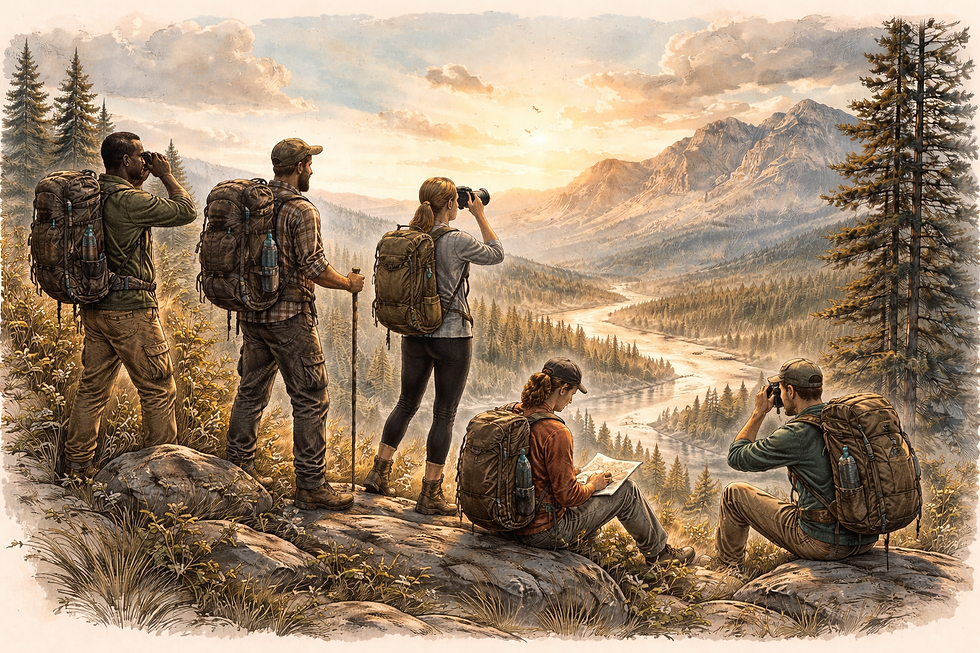
The outdoors has a way of clearing that internal fog without theatrics. A steep trail does not argue with you about whether you feel motivated. A cold morning does not soften itself because you are tired. A long mile under load does not shrink to accommodate distraction. Instead, the land responds directly to effort, and in that response, something steady returns. Strength reveals itself honestly. Weakness becomes visible without shame. Perspective sharpens. When you step back into open air and real terrain, the noise that once felt overwhelming begins to fall into proper proportion.
Reclaiming that clarity does not require abandoning your responsibilities or reinventing your life. It asks only for intentional decisions made consistently. Choosing to wake earlier than one's convenience prefers. Choosing to walk farther than habit suggests. Carrying weight not because anyone demands it, but because resistance builds resilience. Learning a skill that requires patience rather than instant results. Allowing silence to stretch long enough that your own thoughts can settle into coherence. Protecting a patch of ground, whether large or small, because stewardship reinforces belonging.
If the stories here resonate, read them slowly and let them do their quiet work. If they stir memory or possibility, follow along and see where the trail unfolds next. But do not let words replace movement. Let them become a catalyst rather than a consumer. Let them push you toward a trailhead, a riverbank, a pasture, or a park, toward places where air moves freely, and effort reconnects you to something steady. Bring your spouse, your children, or a friend who needs the same reminder, and notice how conversation deepens when screens disappear, and miles are shared instead.
Backcountry Bard exists to reflect on that journey, yet reflection is always secondary to living it. The writing follows the walking. The insight follows the effort. The meaning emerges after the miles accumulate. This space will continue to evolve and deepen. However, its purpose remains simple: to remind you that growth still waits outside familiar routines and that clarity often returns through friction rather than ease.
The horizon remains wide and patient, unchanged by our distraction and unaffected by our delay. It has been there long before we recognized its pull, and it will remain long after hesitation fades. The invitation is steady. Step toward it again, and rediscover what effort, land, and intention can awaken within you.


Comments